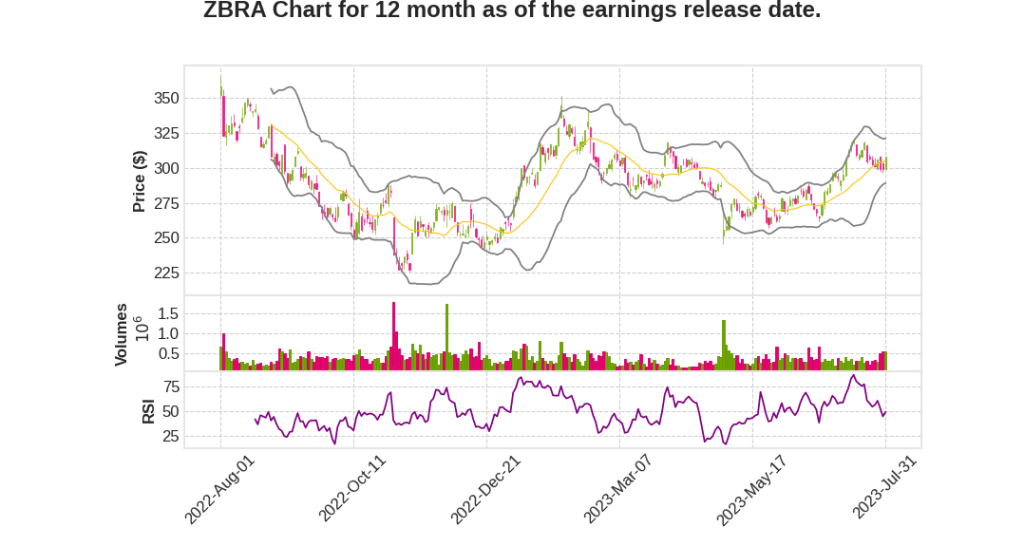
Zebra Technologies Corporation
CEO : Mr. William J. Burns
Quarterly earnings growth(YoY,%)
| Period | Revenue | Operating Income | EPS | Release Date |
|---|---|---|---|---|
| 2023 Q2 | -17.3% YoY | -69.4% | -248.9% | 2023-08-01 |
Bill Burns says,
Weak Second Quarter Results
- Sales of $1.2 billion, a 16% decline from the prior year
- Adjusted EBITDA margin of 21.2%, a 70 basis point decrease
- Non-GAAP diluted earnings per share of $3.29, a 29% decrease from the prior year
Impact of Weakening Demand and Cautious Customer Spending
- Weakening demand and cautious customer spending across all end markets
- Retail and e-commerce and transportation logistics experienced the weakest demand
- Approximately 20% of Q2 sales decline attributed to distributors reducing inventory levels
- Global macro indicators resilient, but goods economy underperforming services economy
- Mobile computing sales declines accelerated following strong demand in previous years
Actions Taken to Address Challenges
- Reducing spending across the organization, including additional restructuring actions for $65 million in annualized savings
- Increasing focus on growth in underpenetrated markets
- Continuing to digitize and automate customer environments
Revised Full-Year Outlook
- Incorporates slowdown and deceleration across end markets
- Significant reduction in near-term demand in mobile computing market
- Destocking by distributors
- Partial year benefit of expanded restructuring actions
- Not expecting a recovery in 2023
Conclusion
- Taking agile approach to manage through uncertain near-term environment
- Expect reset of cost structure and shift of go-to market resources to drive sales growth and improved profitability as end markets recover
Joe Heel says,
Larger customers experiencing larger declines
- The declines in larger customers were larger than in mid-tier and small run-rate business.
- Deals worth hundreds of millions of dollars have been pushed out to the future or disappeared altogether.
Behavior acceleration in Q2
- The behavior of pushing out deals has accelerated in the second quarter.
- In North America, the amount of push-outs relative to the first quarter has tripled.
Examples of push-outs
- A grocer planned to buy $4 million worth of mobile computers in Q2 but decided to postpone the deal to Q3.
- Another grocer planned to buy over $5 million worth of mobile computers in Q2 but requested to spread the purchase over the next five quarters.
- A DIY retailer planned to buy $7 million worth of products in Q2 but had to cut budgets and postpone the project indefinitely.
Customers’ budget pressures
- The push-outs indicate that customers’ budgets are under pressure.
- Customers are trying to extend the timeline for purchasing, which negatively impacts revenue.
Q & A sessions,
Long-term Growth Drivers
- Zebra’s solutions are essential for customers to digitize and automate workflows.
- Secular trends such as automation, mobility, cloud computing, and artificial intelligence drive customer growth strategies.
- Zebra’s enterprise mobile computers are critical to the front line of business and offer significant value.
- Zebra’s RFID solutions are experiencing strong double-digit growth, with expanding use cases throughout the supply chain.
- Investments in machine vision business position Zebra for long-term growth, particularly in warehouse distribution and electric vehicle manufacturing.
- Workflow optimization software offerings, including workforce and task management, communication and collaboration tools, and demand planning, are expected to become EBITDA margin accretive in 2024.
Near-term Demand Challenges
- Sales are currently pressured due to the overall industrial economy slowdown in goods and not services.
- Customers are absorbing capacity bought during the pandemic, leading to reduced demand for Zebra’s solutions.
- Slowing consumer purchases and a reset of e-commerce activity contribute to the decline in transportation logistics and package delivery volume.
- In addition to large customers, mid-tier and smaller customers are also experiencing a slowdown in demand.
Guidance and Expectations
- Demand trends are expected to continue to deteriorate in Q3 and Q4.
- Significantly lower conversion of opportunities within the pipeline is anticipated due to push-outs of large orders by customers.
- Inventory destocking levels will contribute to softer demand in Q3, while Q4 is expected to see less destocking.
- An oversize effect of distributors’ destocking inventory levels is observed as end demand slows.
- An inflection point in demand is expected in 2024, with an exit from year-end at the appropriate inventory levels for distributors’ demand.



 No bad stock